
✔ Fact-checked. For informational purposes only.
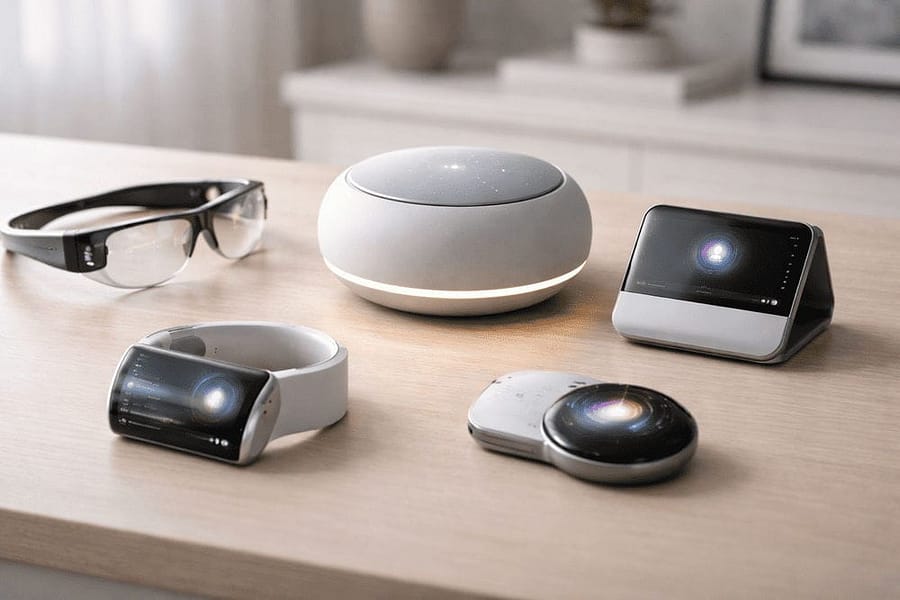
The smartphone has held an undisputed monopoly on our digital lives for nearly two decades. However, 2026 is shaping up to be the year of the “Ambient Pivot.” As artificial intelligence moves from reactive chatbots to proactive agents, the hardware required to access that power is shrinking and shifting. We are entering an era where technology is no longer a screen we stare at, but an invisible layer integrated into our environment. Here are the five AI-first gadgets leading the charge to replace the smartphone in 2026.
1. The OpenAI x Jony Ive “Core Device”
The most anticipated hardware launch of 2026 is the collaboration between OpenAI CEO Sam Altman and legendary former Apple designer Jony Ive. Touted as the “iPhone of AI,” this device is rumored to be a screenless, palm-sized gadget built around natural interaction and emotional well-being. Unlike smartphones that thrive on engagement and notifications, this device uses “Ambient AI” to understand your life through cameras and microphones, handling complex tasks without requiring you to ever look at a display.
The goal is to move personal computing away from the “socially disruptive” nature of the smartphone. By leveraging OpenAI’s most advanced reasoning models (such as the evolved GPT-5 or o-series), this device aims to be a proactive assistant that manages your schedule, communications, and digital life through voice and gesture alone.
2. Google’s Display-Integrated AI Glasses
While the original Google Glass was ahead of its time, the 2026 “Android XR” glasses represent a massive leap in utility. Google is preparing two models: a camera-and-audio only pair (similar to Meta Ray-Bans) and a more advanced “Display AI” version. These glasses feature an in-lens display that privately overlays information directly onto your field of vision.
- Turn-by-Turn Navigation: Arrows projected onto the actual sidewalk in front of you.
- Real-Time Translation: Captions appearing under a person as they speak a foreign language.
- Gemini Integration: A visual assistant that can “see” what you see and answer questions about your surroundings in real-time.
3. The Samsung “Ballie” Next-Gen Home Robot
As we spend more time in hybrid work environments, the “smartphone” role is being split between wearables and home robotics. Samsung’s Ballie, set for a major 2026 push, acts as a mobile AI hub. It isn’t just a vacuum or a pet-sitter; it is a projector and communication center that follows you from room to room. In 2026, Ballie is expected to handle calls, manage smart home safety, and project your digital workspace onto any wall, effectively replacing the need for a handheld screen while at home.
4. Predictive AI Health Wearables (Apple Watch & Oura)
In 2026, health wearables are moving from “tracking what happened” to “predicting what will happen.” The next generation of Apple Watch and smart rings like Oura are integrating AI that analyzes biometrics to detect illness, fatigue, or cardiovascular strain days before symptoms appear. With the addition of continuous glucose monitoring and needle-free blood testing, these devices provide a level of essential utility that a smartphone cannot match, making the “phone” part of the equation feel increasingly secondary to the “health” part.
5. Rabbit’s “Three-in-One” Agentic Device
Following the experimental Rabbit R1, the company is prototyping a “three-in-one” form factor for 2026. This second-generation device focuses on “Agentic AI”—the ability for the device to actually execute tasks within apps (like booking a flight or ordering groceries) rather than just talking about them. By 2026, Rabbit expects AI agents to be fast enough to replace the graphical user interface (GUI) of a phone with a Large Action Model (LAM), allowing for a much smaller, button-centric device that handles everything a smartphone does via a “headless” cloud OS.
Comparison: Smartphone vs. 2026 AI Gadgets
FeatureTraditional Smartphone2026 AI GadgetsInterfaceTouchscreen / GUIVoice, Vision, & GesturesInteractionReactive (You ask)Proactive (It suggests)Social ImpactHighly DistractiveAmbient & DisconnectedPrimary GoalEntertainment/MediaTask Execution/Health
Frequently Asked Questions
Will these devices actually work without a phone?
While some (like the OpenAI device) are designed to be standalone with their own cellular service, many 2026 AI glasses will still use a smartphone in your pocket for heavy processing, though you will rarely need to take the phone out.
Is my privacy safe with “always-on” AI cameras?
Privacy is the biggest hurdle for 2026. Companies are moving toward “Edge AI,” where data is processed locally on the device rather than sent to the cloud, and incorporating physical shutters or LED indicators to show when a camera is active.
Are these gadgets affordable?
Initially, “first-mover” devices like the Sam Altman/Jony Ive project are expected to carry premium price tags (above $600). However, budget options like the Rabbit or Tapo-integrated wearables are targeting the $200-$300 range.
Can I still use social media on these devices?
Social media is shifting. Instead of scrolling a feed, AI gadgets will “summarize” the updates you care about or allow you to post hands-free via voice-activated cameras.
Conclusion: The End of the “Screen” Era
The smartphone won’t disappear overnight, but its status as the “center of the universe” is fading. By 2026, the convergence of high-speed 6G/5G, advanced LLMs, and wearable optics will make the act of pulling a glass slab out of your pocket feel antiquated. Whether it is through the stylish frames of Google’s AI glasses or the minimalist “core device” from OpenAI, the future of personal technology is becoming invisible. Ditching your phone for 5 AI-first gadgets that could replace your smartphone in 2026 is no longer a sci-fi fantasy—it is the next logical step in our digital evolution.
📚 AI Technology & Privacy References
-
NIST (National Institute of Standards and Technology):
AI Risk Management Framework
(US Government standards for the safety and reliability of Generative AI) -
Stanford University (HAI – Human-Centered AI):
The AI Index Report
(Comprehensive academic data on AI hardware trends and adoption rates) -
FTC (Federal Trade Commission):
Consumer Protection: AI Product Claims
(Official guidance on truth-in-advertising for AI-powered devices)
Disclaimer
This information is for educational and informational purposes only and does not constitute professional advice. Always consult with a qualified professional before making any decisions based on this content.
About the Expert
Alex Chen
Lead Technology Analyst & Smart Living Editor at FactaHub
Alex Chen leads the editorial direction and technical analysis for FactaHub’s Tech & Smart Living category. He is responsible for critically assessing new technologies and trends, ensuring that all published guides provide clear, unbiased, and actionable advice to readers seeking to integrate smart technology into their daily lives. Alex has nearly a decade of experience analyzing consumer electronics and developing user-centric solutions. Alex oversees a strict editorial process to maintain the credibility of FactaHub’s tech content, focusing on user safety, practicality, and longevity of tech products.
—