
✔ Fact-checked. For informational purposes only.
In 2026, the roar of a gas engine on a Saturday morning is becoming a relic of the past. As smart home technology extends its reach from the living room to the backyard, smart lawn mowers have evolved from novelty gadgets into essential landscaping tools. For U.S. homeowners aged 35 to 70, the question is no longer if you should automate your mowing, but how to go about it. Should you purchase a high-tech consumer model and install it yourself, or hire a professional dealer to deploy a commercial-grade system?
This decision impacts not just your budget, but your long-term comfort and the safety of your garden ecosystem. Whether you are managing a quarter-acre suburban plot or a sprawling estate, understanding the distinction between DIY and professional solutions is critical to reclaiming your weekends.
The Problem: The Hidden Cost of Traditional Mowing
Traditional mowing is resource-intensive. Beyond the physical sweat and time commitment—averaging 40 hours per year for a typical half-acre lawn—there are hidden costs. Gas mowers emit significant pollutants and noise pollution that disrupts neighborhood peace. Furthermore, the “cut and collect” method often deprives the soil of nutrients.
Smart lawn mowers solve these problems by operating quietly, autonomously, and continuously. They trim the grass by millimeters daily, acting as a natural mulcher that fertilizes your lawn while you sleep or work.
Category 1: The DIY Route (Consumer-Grade Models)
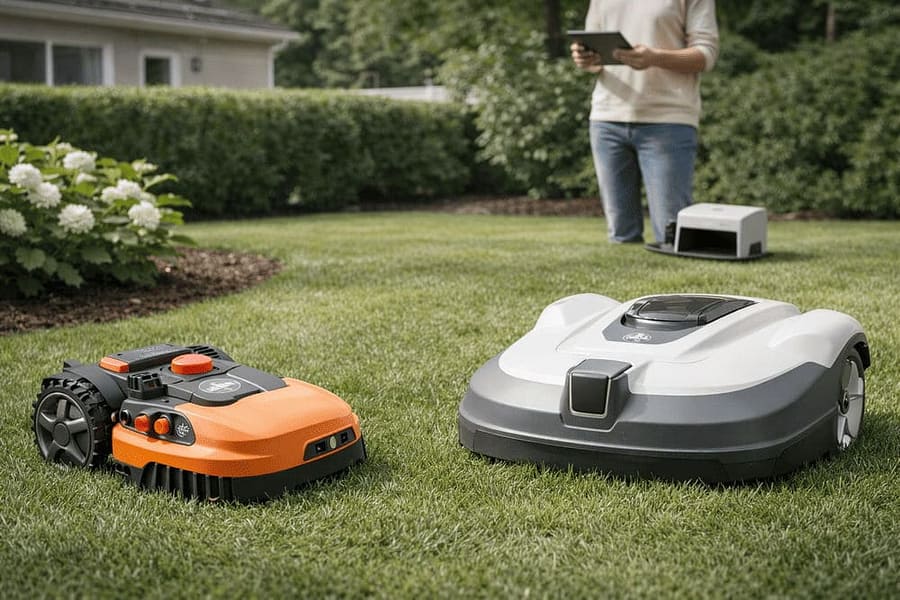
The “Do-It-Yourself” category has exploded in 2026, largely driven by wire-free technology. These are units you buy online or at a hardware store and set up using a smartphone app.
Pros of DIY Smart Mowers
- Cost-Effective: You avoid installation fees and dealer markups. High-end consumer models often cost 30-50% less than their professional counterparts.
- Cutting-Edge Tech: Consumer brands (like Segway, Mammotion, and Eufy) often iterate faster, introducing features like AI-vision obstacle avoidance and pattern mowing (stripes) more aggressively.
- Total Control: You own the mapping process. If you add a flower bed, you can redraw the zone in the app immediately without waiting for a service technician.
Cons of DIY
- Support & Repair: If it breaks, you are the IT support. You may need to ship the unit back for repairs, leaving your grass to grow wild in the meantime.
- Setup Curve: While “wire-free” sounds easy, configuring RTK (GPS) antennas requires precise placement to avoid signal loss from trees or walls.
Category 2: The Professional Route (Dealer-Installed Systems)
Professional solutions, dominated by legacy brands like Husqvarna and Stihl, operate on a service-first model. You aren’t just buying a machine; you are buying a guaranteed result.
Pros of Professional Systems
- Reliability & Durability: These units are built to run thousands of hours. They often use buried guide wires that, while “old school,” are impervious to satellite signal loss.
- On-Site Support: If the mower stops working, a local dealer comes to your house to fix it. For seniors or busy professionals, this “hands-off” peace of mind is invaluable.
- Complex Terrain Handling: Pro models often feature superior all-wheel drive systems capable of handling steep slopes (up to 70% grade) that would flip a consumer unit.
Cons of Professional Systems
- Higher Upfront Cost: Between the hardware and the professional installation labor, the initial investment is significant.
- Slower Updates: Firmware updates and new features may roll out slower than in the agile consumer tech market.
Buying Guide: Key Features to Watch in 2026
Regardless of which path you choose, ensure your device checks these safety and performance boxes.
- Object Detection (AI Vision): Essential for families with pets or grandchildren. The mower should “see” a dog toy or a sleeping pet and route around it, not just bump into it.
- Rain Sensors: Smart mowers should know when to return to base to avoid cutting wet grass, which clumps and damages the turf.
- Anti-Theft Geofencing: Look for models with GPS tracking and loud alarms that trigger if the device is lifted or moved outside its zone.
- Slope Rating: Measure your steepest hill. If your lawn has a 30% slope, buy a mower rated for 40% to ensure traction.
Frequently Asked Questions
Do wire-free mowers work under big trees?
It depends on the technology. Vision-based mowers (using cameras) work well under canopy. RTK-GPS mowers need a clear view of the sky and may struggle with heavy tree cover unless they have hybrid vision assistance.
What happens to the grass clippings?
There are no clippings to rake. Smart lawn mowers mulch the grass into fine dust that settles into the soil, acting as a natural fertilizer and retaining moisture.
Are they safe for pets?
Modern units with AI cameras are very safe and will stop or divert when they detect movement. However, we always recommend scheduling the mower to run when pets are indoors, such as at night or during work hours.
How long do the batteries last?
A typical lithium-ion battery in a mower lasts 3 to 5 years before needing replacement. Most DIY models allow user-replaceable batteries, while pro models may require a dealer visit.
Conclusion
The choice between DIY and professional smart lawn mowers ultimately comes down to your “tech tolerance” and your terrain. If you enjoy optimizing gadgets and have a relatively open yard, a DIY wire-free model offers incredible value and advanced features for 2026. However, if your property has heavy tree cover, steep hills, or you simply want a “set it and forget it” solution with guaranteed local support, a professional dealer-installed system is the wiser investment.
Automating your garden is one of the most rewarding smart home upgrades available. It returns hours of free time to your week and results in a healthier, greener lawn—no sweat required.
Disclaimer
This information is for educational and informational purposes only and does not constitute professional advice. Always consult with a qualified professional before making any decisions based on this content.
About the Expert
Alex Chen
Lead Technology Analyst & Smart Living Editor at FactaHub
Alex Chen leads the editorial direction and technical analysis for FactaHub’s Tech & Smart Living category. He is responsible for critically assessing new technologies and trends, ensuring that all published guides provide clear, unbiased, and actionable advice to readers seeking to integrate smart technology into their daily lives. Alex has nearly a decade of experience analyzing consumer electronics and developing user-centric solutions. Alex oversees a strict editorial process to maintain the credibility of FactaHub’s tech content, focusing on user safety, practicality, and longevity of tech products.
📚 Safety Standards & Performance Testing
- OPEI (Outdoor Power Equipment Institute):
ANSI/OPEI Robotic Mower Safety Standards
(The official industry standard (B71.10) that professional mowers must meet—and DIY builds often lack) - Consumer Reports:
Robotic Mower Reliability & Testing
(Independent lab tests comparing cutting performance, slope handling, and battery life of top brands) - CPSC (U.S. Consumer Product Safety Commission):
Power Lawn Mower Safety Guidelines
(Federal safety data on blade injuries, emphasizing the importance of sensor-based auto-shutoff features)