
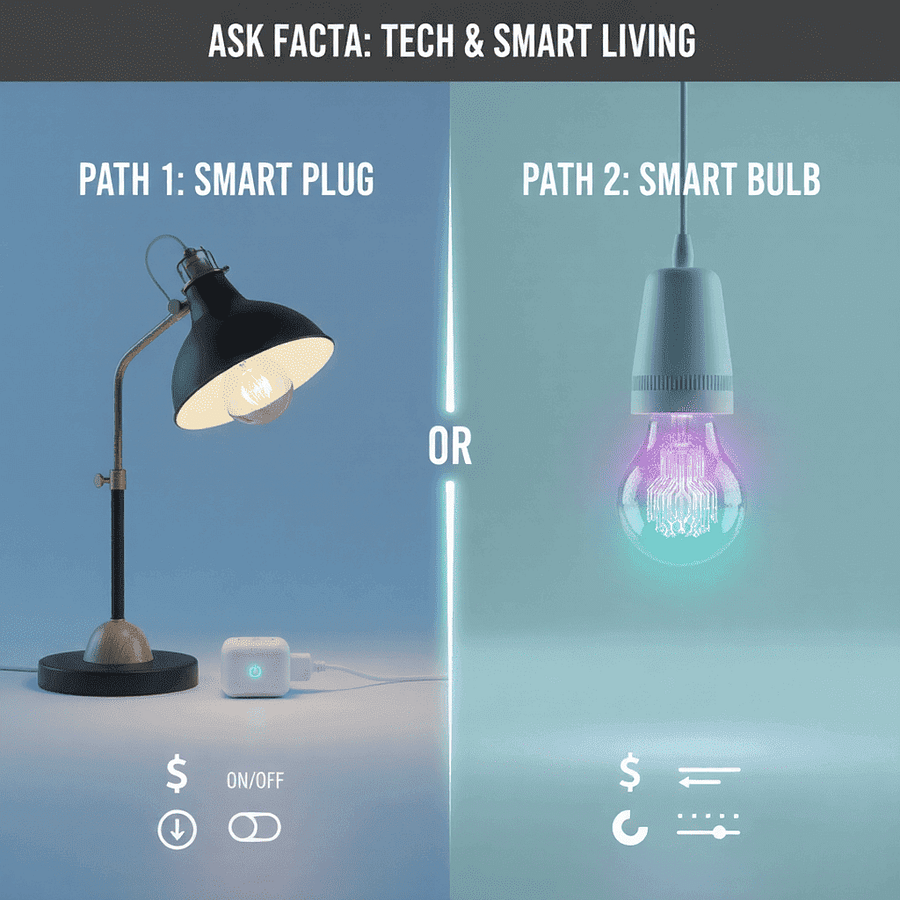
Ask Facta: Tech & Smart Living
Our dear readers ask us questions every day, especially when the goal is to cut down on unnecessary energy use caused by simple forgetfulness. The choice between a smart plug and a smart bulb is a foundational one when starting home automation.
Both devices solve the core problem of remote control, but they represent two different cost and functionality profiles. As a rational consumer, you need to know which device provides the fastest ROI (Return on Investment) based on your needs: basic ON/OFF control or advanced lighting features. We analyze the investment through the lens of longevity and the total feature set.
Path 1: The Versatile and Cost-Saving Investment: Smart Plug
The smart plug is an adapter that converts any existing electrical outlet into a smart one, instantly bringing basic remote control to anything plugged into it. This makes it highly versatile. It is typically a low-cost, one-time investment that can be repurposed later if your lighting setup changes, serving as a solution for fans, humidifiers, or even seasonal decorations.
Cost & Installation: The initial investment is minimal. A quality smart plug typically costs between $10 and $20. Installation is instantaneous—plug it in and connect to your Wi-Fi. Since you continue to use your current light bulbs, you defer the higher cost of proprietary smart lighting. This approach is ideal for households focusing strictly on cost-cutting measures without valuing advanced lighting customization.
Functional Limits and Longevity: The primary functional limitation is the lack of granular control; you can only switch the power ON or OFF. You lose the ability to dim the lights or change colors, which are key components of modern smart living experiences. However, the longevity of the plug is high because its function (switching power) is universal and rarely obsolete, offering a long lifespan even as lighting trends evolve.
Path 2: The Integrated and Feature-Rich Investment: Smart Bulb
A smart bulb is a dedicated lighting device that replaces a traditional bulb. It features built-in Wi-Fi or Bluetooth and sophisticated control capabilities beyond simple power switching. Smart bulbs offer full dimming, color changes (RGB), and color temperature tuning (cool white for focus to warm yellow for winding down).
Cost & Installation: The upfront cost per bulb is significantly higher than a basic plug, especially for color-changing models, which can range from $25 to $50 each. While installation is as simple as screwing in a bulb, the total cost for outfitting an entire room can escalate quickly. The major benefit is the superior lighting experience, allowing for intricate automation scenes triggered by time, motion, or other devices within your ecosystem.
Functional Benefits and Efficiency: Smart bulbs are inherently integrated and cleaner solutions—they do not occupy an outlet, and they are almost universally energy-efficient LEDs. Their ability to deliver customized light temperatures and brightness levels allows for improved adherence to circadian rhythms. However, they are susceptible to accidental power loss if the physical wall switch is turned off, which can disconnect them from the network, requiring manual intervention.
Our Take: Ask Facta
In our opinion, the choice depends on your usage profile and infrastructure complexity. We urge the rational consumer to consider Total Cost of Ownership (TCO) over a three-year span and the value you place on light quality versus simple control.
If your priority is the lowest initial outlay and basic remote control: Choose the Smart Plug. It provides the fastest ROI for solving forgetfulness and offers the most versatility, as it can be easily moved to control any non-lighting appliance later. This is the ultimate cost-saver’s solution that keeps your initial hardware expense minimal while solving the core problem.
If your priority is integrated functionality, atmosphere control, and a superior user experience: Choose the Smart Bulb. While more expensive initially, the ability to control color, dimming, and scheduling unlocks the full potential of smart lighting. This investment enhances the quality of life in your smart home, providing value that outweighs the cost over time.
Related Facta Resources
For a comprehensive analysis of this topic, read our full expert guide: The 2025 Comprehensive Guide to Energy-Saving Smart Home Devices.