
Quick Answer:
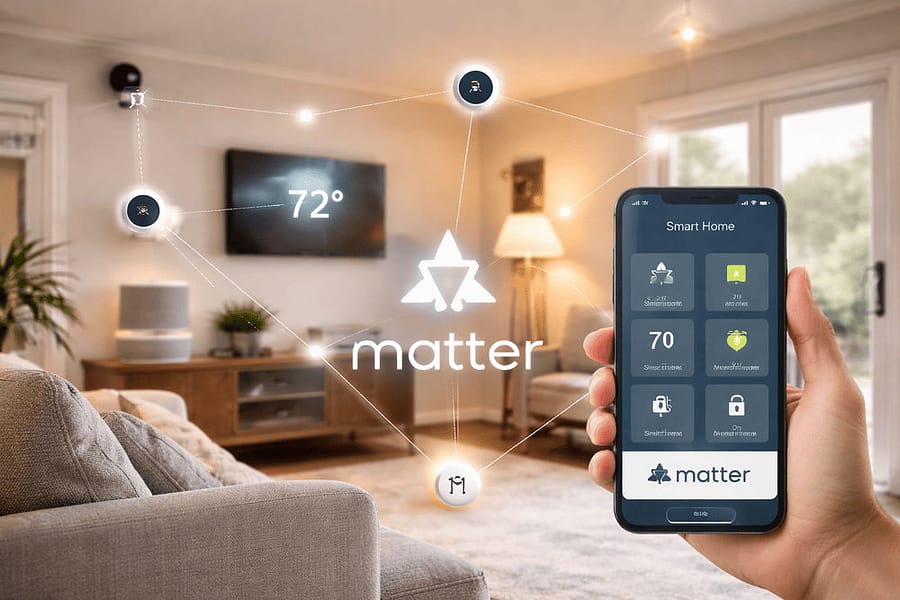
Matter is a new universal smart home protocol that allows devices from different brands (Apple, Google, Amazon, Samsung) to work together seamlessly. In my experience, it finally solves the “walled garden” problem, letting you control a Nest thermostat with an Apple HomePod or a Siri command without complex workarounds.
The Smart Home Headache I Wanted to Solve
If you are like me, your smart home probably looks like a digital Frankenstein. I have a Google Nest doorbell, Amazon Alexa in the kitchen, and Apple HomeKit for my lights. For years, making these devices “talk” to each other required third-party bridges or hours of frustrating setup.
When the Matter 1.0 standard was released, I decided to see if it lived up to the hype. Could one protocol really unite the smart living ecosystem?
What Exactly is Matter? (In Simple Terms)
Think of Matter as a universal language for smart devices. Before Matter, devices spoke different “languages” (Zigbee, Z-Wave, proprietary Wi-Fi). Now, if a product has the Matter logo, it is guaranteed to work with any major smart home platform.
- Reliability: It runs locally over your network, not the cloud.
- Security: Built-in encryption for every connection.
- Simplicity: You just scan a QR code, and the device is added.
My Test Setup: Integrating Different Brands
To test this, I bought a few Matter-enabled smart plugs and light strips. Here is what happened during my real-world installation:
| Feature | Old Way (Pre-Matter) | The Matter Experience |
|---|---|---|
| Setup Time | 10-15 minutes + extra apps | Under 2 minutes |
| Compatibility | Only works with one ecosystem | Works with everything |
| Internet Reliance | Fails if Wi-Fi goes down | Local control (More stable) |
What You Need to Get Started
Based on my experience, you don’t need to throw away all your old gear, but you do need a Matter Controller. This is the “brain” of your smart home. Good news: you probably already own one.
- Apple: HomePod Mini, HomePod (2nd Gen), or Apple TV 4K.
- Google: Nest Hub (2nd Gen) or Nest Wi-Fi Pro.
- Amazon: Echo (4th Gen) or newer.
The Pros and Cons: A Reality Check
The Good:
The speed is incredible. When I press “Off” in my app, the lights react instantly. No more “Device Unresponsive” errors that were so common with older Wi-Fi bulbs.
The Challenges:
It’s not perfect yet. Not every type of device is supported. While lights and plugs work great, advanced features for some specialized sensors are still being rolled out in newer updates (Matter 1.2 and 1.3).
How Matter Improves “Smart Living”
For me, the biggest win was Energy Management. By using Matter-compatible smart plugs, I was able to link my desk setup to my energy-saving routines in a way that wasn’t possible before. When my computer shuts down, Matter triggers the peripherals to turn off, saving me an extra few kWh per month.
Frequently Asked Questions
Q: Do I need to replace my old Zigbee devices?
A: Not necessarily. Many brands (like Philips Hue) have released Matter bridges that bring your old devices into the new standard.
Q: Is Matter safer than Wi-Fi devices?
A: Yes. Matter devices don’t need to connect to a manufacturer’s server to work, which reduces the “holes” in your home network security.
Final Thoughts
Matter is finally making the “Smart Home” feel actually smart. It removes the stress of checking labels for compatibility and lets you focus on building a home that works for you. If you are starting your smart living journey in 2026, my advice is simple: Look for the logo.
About the Expert
Edward Dniprovoi
Founder & Senior Technical Analyst
Edward is an Energy Systems Engineer with two decades of experience in industrial automation and power management. A specialist in high-voltage electrical safety and emergency power systems, he now focuses on making complex technology accessible—from home energy independence to the latest in smart infrastructure. He oversees the technical integrity of all content on FactaHub.com.